
Absenteeism and resignations: what they really cost, and how recognition drives them down
Two indicators, one bill that keeps climbing. We put concrete figures on the cost of absenteeism and resignations, with ready-to-use tables, then we show why recognition at work is your best ally to bring them down.

Two silent leaks in company budgets
Average absenteeism rate in France in 2024, a record. That is around 23 days of absence per employee per year.
Average cost of absenteeism per employee per year, for a national total estimated around €108 billion.
Cost of replacing an employee who resigns, expressed as a share of their annual salary depending on the role and seniority.
Share of employees who say they are engaged at work in Europe. Disengagement feeds both absence and departure.
Sources: Ayming Absenteeism Barometer 2024, Gallup (State of the Global Workplace 2023 and replacement cost).
How much it costs you, by rate and headcount
Find your row (your rate) and your column (your headcount). The cell where they meet gives the order of magnitude of the annual cost. The darker the cell, the heavier the bill.
Table 1 · Estimated annual cost of absenteeism (€)
Rows: absenteeism rate. Columns: headcount. Estimate calibrated on the Ayming benchmark (around €4,000 per employee at 4.5%), direct and indirect costs combined.
| Rate \ Headcount | 50 | 100 | 250 | 500 | 1000 |
|---|---|---|---|---|---|
| 2% | €90k | €180k | €440k | €890k | €1.8M |
| 4% | €180k | €360k | €890k | €1.8M | €3.6M |
| 6% | €270k | €530k | €1.3M | €2.7M | €5.3M |
| 8% | €360k | €710k | €1.8M | €3.6M | €7.1M |
| 10% | €440k | €890k | €2.2M | €4.4M | €8.9M |
Table 2 · Estimated annual cost of resignations (€)
Rows: resignation rate (turnover). Columns: headcount. Replacement assumption used: around 6 months of salary per departure (close to €22,500). According to Gallup, the real range runs from 50 to 200% of annual salary.
| Rate \ Headcount | 50 | 100 | 250 | 500 | 1000 |
|---|---|---|---|---|---|
| 5% | €56k | €110k | €280k | €560k | €1.1M |
| 10% | €110k | €230k | €560k | €1.1M | €2.3M |
| 15% | €170k | €340k | €840k | €1.7M | €3.4M |
| 20% | €230k | €450k | €1.1M | €2.3M | €4.5M |
| 25% | €280k | €560k | €1.4M | €2.8M | €5.6M |
These tables give orders of magnitude to size the stakes. Real amounts depend on your payroll, your sectors and the nature of the roles involved.

Behind the numbers, a lack of recognition
An employee rarely goes absent or leaves overnight. Most of the time, they disengage first. They give less, feel less useful, then ease off or leave. This disengagement has a very concrete cause: the feeling of not being seen, nor recognized for what they bring.
The figures confirm it: more than half of employees say they receive no recognition, or recognition that does not really count. Yet this is precisely the signal that keeps people and gets them moving again.
Three examples to make the numbers concrete
A 100-employee SMB
At 6% absenteeism, the annual bill is around €530k. Bringing that rate down to 4% saves close to €180k a year, without laying anyone off.
A 500-employee mid-market firm
At 15% turnover, replacing leavers costs around €1.7M a year. Every point of turnover saved represents more than €110k recovered.
A 1000-employee group
Absenteeism at 8% weighs around €7M a year. At this scale, two points of absenteeism less easily fund a real recognition program.
Recognition, your best ally against absenteeism and resignations
The research is clear. Employees who received high-quality recognition in 2022 were 45% less likely to have left their job two years later. Recognition works where pay rises alone fail: on the sense of belonging, the desire to stay and daily energy.
It feeds the three drivers of intrinsic motivation: feeling competent, feeling free to act, feeling connected to others. An employee who experiences that goes absent less and stays longer.
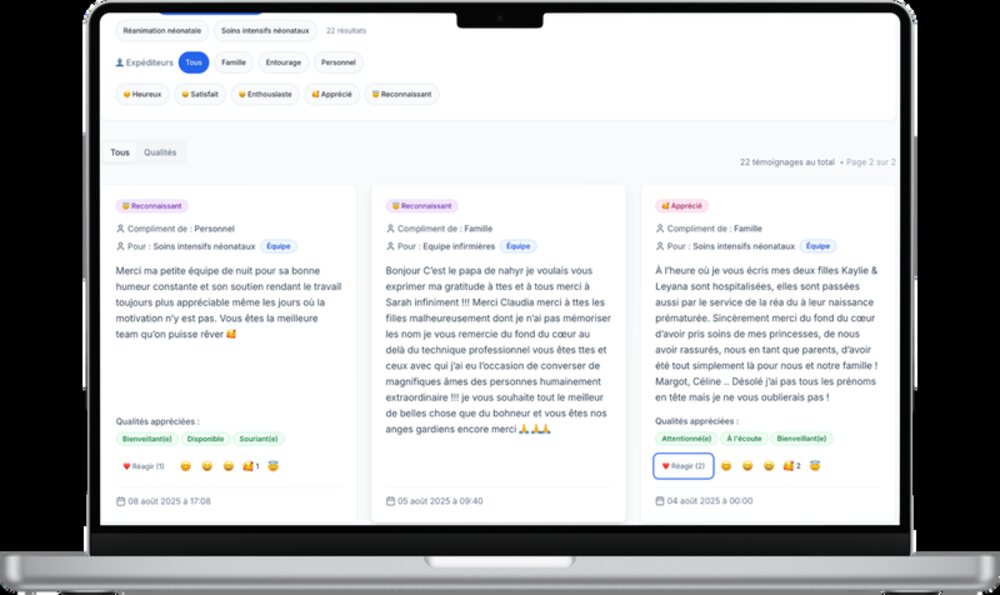
Management must learn to recognize, just as it learned to set objectives
Absenteeism and resignations are not inevitable. They are the symptoms of a damaged bond between people and their work. Recognition is the management gesture that repairs that bond, provided it is practiced often, sincerely, and made easy for everyone.
That is exactly what we install with Listen Leon: a daily, measurable practice of recognition that circulates gratitude and makes people want to stay. Two points of absenteeism or turnover less are often enough to more than fund the approach.
Let's talk about your situation