
Guide · Recognition at Work
The Lack of Recognition at Work
It's one of the leading drivers of demotivation and disengagement, across every sector. It sets in quietly, rarely all at once. Understanding how it starts is the first step to preventing it.

What we mean
Far more than a missing thank you
A lack of recognition isn't just a forgotten thank you. It appears when a lasting gap forms between the effort someone gives and the recognition they receive.
In practice, the person feels that their real work goes unseen, that their extra effort is treated as normal, and that the value of their role is never acknowledged.
A gradual condition
It builds up in stages
A lack of recognition is rarely sudden. It creeps in slowly, which is exactly what makes it hard to spot.
- First, mild demotivation.
- Then, emotional distance.
- Next, deeper fatigue, sometimes tinged with cynicism.
- Finally, for some, they leave.
The warning signs
What should catch your attention
In a person
- They stop mentioning their achievements, even significant ones.
- They cut back on initiative and stick strictly to their job description.
- They show weariness or irony about the value of their work.
- They mention opportunities elsewhere, without a clear plan.
In a team
- Absenteeism rises.
- Turnover climbs.
- Participation in shared moments drops.
- Tensions between departments multiply.
What the research shows
The scale of the problem, in numbers
8%
of French employees say they are engaged at work.
9%
of global GDP is the estimated cost of disengagement.
73%
of caregivers don't feel recognized for their work.
4%
of French teachers feel their role is valued, the lowest in the OECD.
Sources: Gallup, State of the Global Workplace, for engagement and the cost of disengagement. The imbalance between effort given and recognition received, described by Siegrist's model, increases the risk of burnout.
If you are the one experiencing it
Lack of recognition at work: what to do about it
This page speaks to organisations first. But if you landed here because you do not feel recognised in your own job, here is what genuinely helps, before you start thinking about leaving.
Separate what is you from what is the system
Ask a simple question: do the people around you get any feedback at all? If nobody does, the problem is organisational and working harder will not fix it. If you are the only one, the conversation to have is a different one.
Make your real work visible
Most of the work never shows: the problems avoided, the colleagues covered for, the files rescued. Write it down as it happens. That is not self-promotion, it is the factual material for a conversation.
Ask for feedback, not for credit
Wording decides the outcome. A complaint closes the conversation. Naming what you delivered, the effect it had, then asking how it is seen, opens it. Ask for a read on your work, not for a reward.
Give what you are waiting for
It can feel unfair, and it is still what the research shows. In a four-week study at Coca-Cola Iberia, employees who received small acts of recognition went on to perform almost three times as many themselves as the control group. Someone has to start.
One honest limit. If your situation involves harassment, exclusion or distress that has lasted, this is no longer a recognition issue. Speak to occupational health, a staff representative or your doctor.
The causes
Why it takes hold, even in teams that get along
We flag what goes wrong and stay quiet about what goes right
A late file triggers an email. A file delivered on time triggers nothing. Over time only the negative circulates, and everyone concludes their work goes unnoticed.
Saying it out loud feels awkward
Plenty of people think highly of their colleagues and never say so. Saying it takes a kind of courage that daily work does not encourage.
Managers have no bandwidth left
Twelve people to follow, meetings back to back, decisions to make. Recognition comes after all of it, every week, until it stops coming at all.
Invisible work stays invisible
Support functions, night shifts, remote sites, field staff. The people whose work is never seen get the least feedback, while the organisation would stop without them.
Remote work removed the micro-signals
The nod, the word in the corridor, the coffee after a hard meeting. None of it survives a video call, and nothing has replaced it.
Kindness gets mistaken for recognition
On our platform we measure what people actually write to each other. Half the messages are kindness and compliments, a quarter are appreciation, and only 18 % are recognition in the full sense. The goodwill is there, the practice is missing.

Why it stalls
Good intentions aren't enough
Wanting to recognize people isn't enough. Recognition that depends on chance, on available time, or on personality always ends up fading away.
What isn't structured doesn't last. Recognition works far better when it's preventive, regular and shared, rather than curative and occasional.
Breaking the cycle for good
Four conditions that change everything
See the real work
Recognize the effort and the gesture, not just the final result.
Make it easy day to day
Make expressing recognition simple, at any moment.
Don't put it all on managers
Colleagues, clients and service users have a say too.
Build rituals
Simple, regular, sincere moments that last.
A question that keeps coming up
The four forms of recognition at work
The reference framework comes from Jean-Pierre Brun and Ninon Dugas at Université Laval, in 2002. They describe four distinct forms. Most organisations practise only one of them.
Existential
Recognising the person, not only the employee. Their right to speak, their influence on decisions, their place in the group.
Work practice
Recognising how the work is done. The skills applied, the creativity, the way a difficult situation was handled.
Investment
Recognising the effort put in, even when the result did not follow. The most forgotten form, and often the one people want most.
Results
Recognising what was produced, the usefulness and quality of the work delivered. The only one most organisations really practise.
An organisation that recognises results alone leaves out everyone whose work is hard to measure, and everyone who gave a great deal to a project that did not land.
On the organisation's side
What a lack of recognition ends up costing
Replacement
A departure is paid for in recruitment, in an empty seat, in training and in ramp-up time. Lack of recognition comes up constantly in exit interviews and almost never in the official reasons.
Absence
A lasting imbalance between effort spent and recognition received, described by the Siegrist effort-reward model, is associated with a higher risk of burnout. The absences that follow are long ones.
Silent withdrawal
The most expensive and the least visible. The person stays, does what is asked, and nothing more. No indicator catches it, and collective performance drops anyway.
Harder hiring
What your teams live through always gets out eventually. Online reviews and word of mouth do the rest, and the cost moves to recruitment.

The Listen Leon connection
Making recognition stick, for good
Listen Leon makes real contributions visible, makes it easy to express authentic thanks, and involves everyone: managers, colleagues, clients and service users.
Recognition becomes an everyday gesture, not a one-off event.
By sector
A lack of recognition doesn't look the same everywhere
We adapt our approach to your reality on the ground.
Frequently asked questions
The lack of recognition, explained
Is a lack of recognition just about not saying thank you?
Is this an individual problem?
What are the first signs?
Where should a manager start?
How does Listen Leon help?
Are messages moderated?
What does a lack of recognition at work actually mean?
What are the signs you are not appreciated at work?
What can you do when you feel unrecognised at work?
What are the four forms of recognition at work?
Don't let the silence set in
Let's look together at how to build fair, regular recognition into your teams.
Request a demoGo further
Case study · AP-HM, Marseille
A unit that turned it around
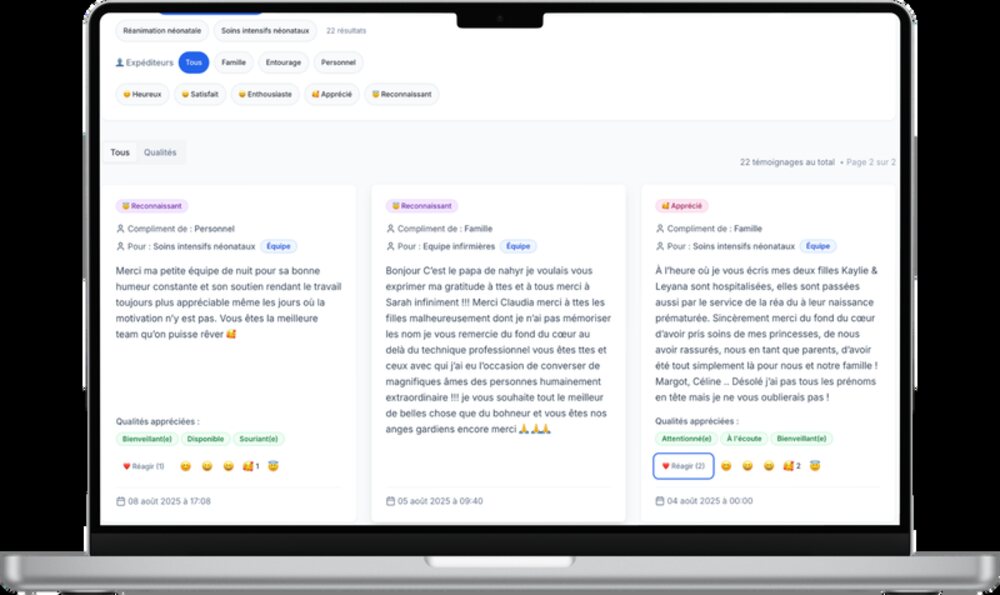
In neonatal intensive care, staff only ever heard about incidents. Now families write. 54 thank-you messages in ten months.
Read the case study