
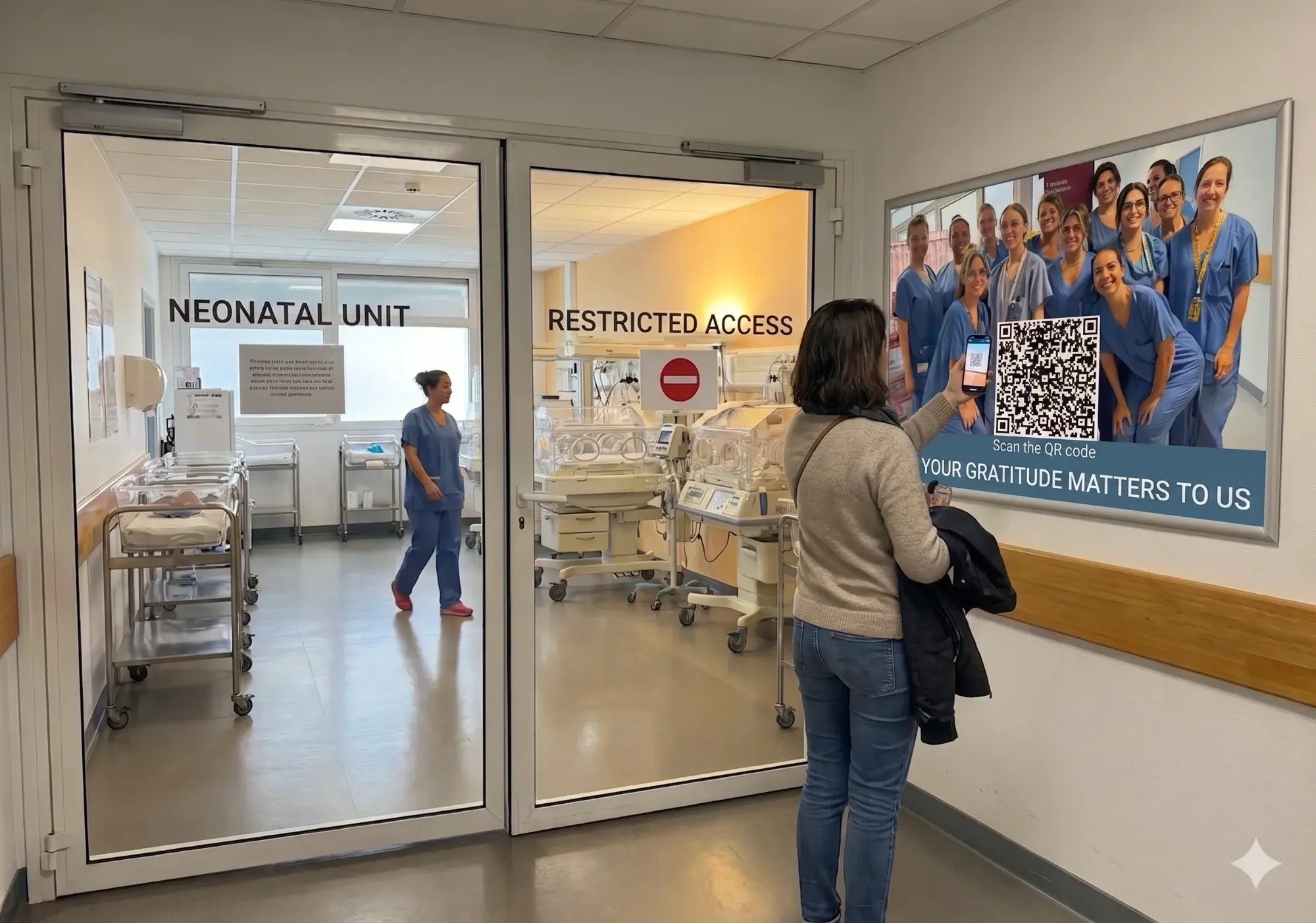
Caregivers give everything. Let’s bring patients' and families' gratitude back to them.
Patients, families and staff thank caregivers through a simple QR code. Anonymous if needed, moderated, and read.
Hospitals, nursing homes, private practices, clinics: Listen Leon adapts to every kind of care setting.
Over 500,000 thank-you messages already exchanged.
In healthcare, the lack of recognition is cultural
Trained to spot errors
Medical culture teaches how to see what goes wrong, not how to name what goes well.
Gratitude already exists
Among patients, families and colleagues. But it too often stays silent.
One simple channel
We install it so this recognition finally becomes visible and regular.
of healthcare workers say they do not feel recognized.
Recognition in four simple steps
At the entrance to the ward, in the room, on a caregiver's badge, or on the way out. Nothing to install.
Happy, grateful, touched... the right word for what you feel.
Signed or anonymous, in 30 seconds, to one person or a whole team.
The app makes sure it truly reaches its recipient.
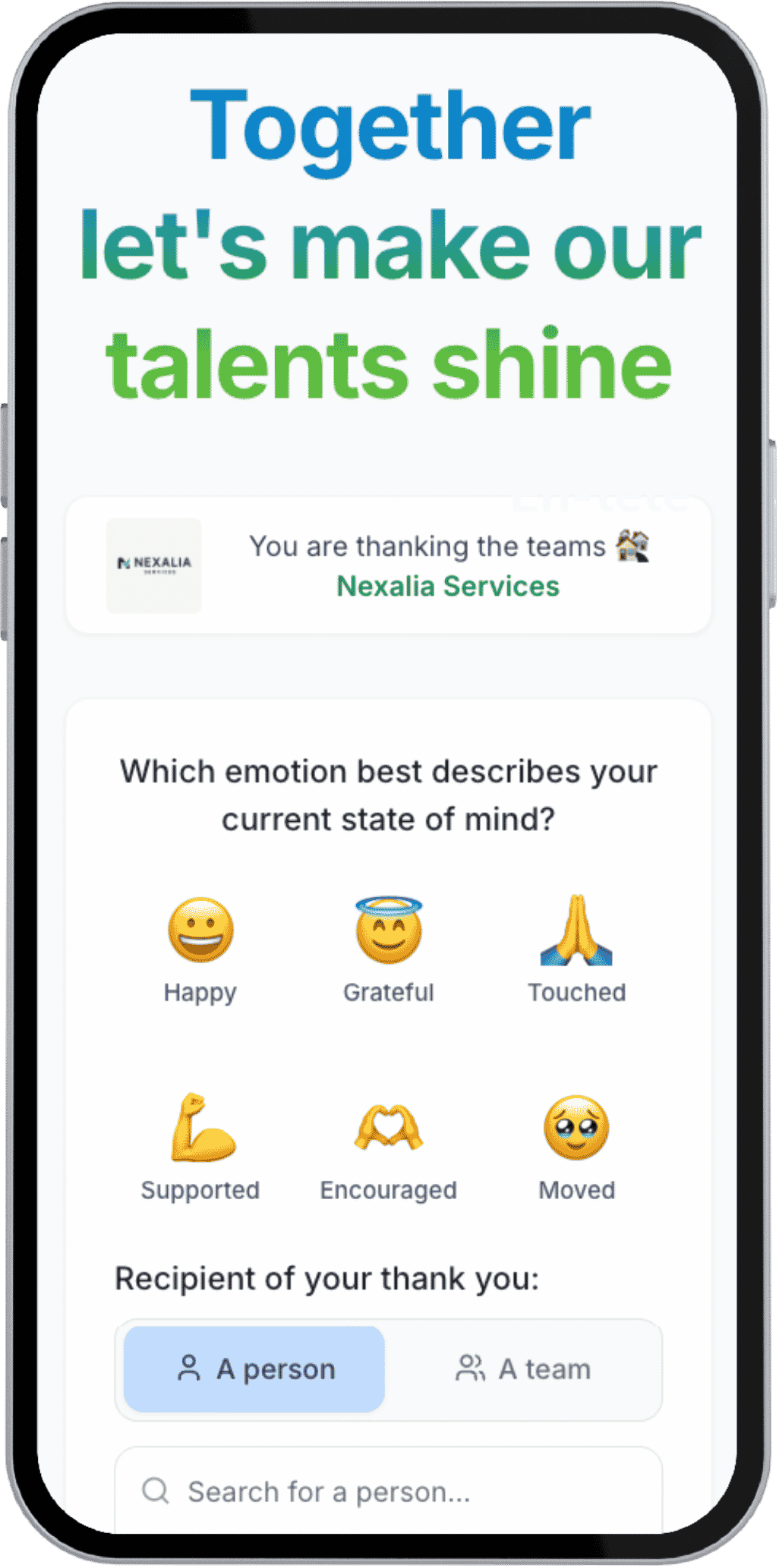
What it looks like, for real
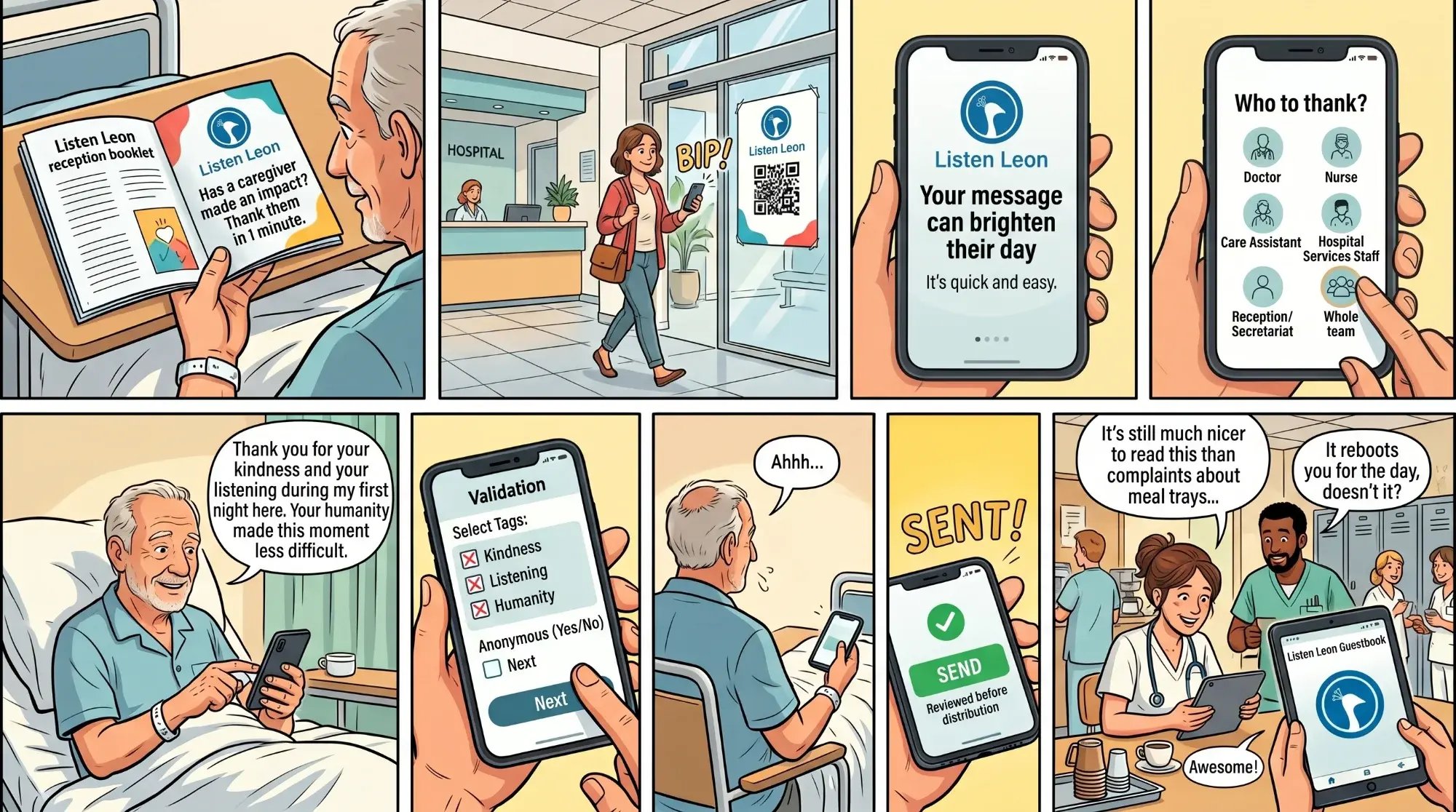
From the welcome booklet to the team's gratitude wall: the patient-caregiver recognition journey, step by step.
Messages like these
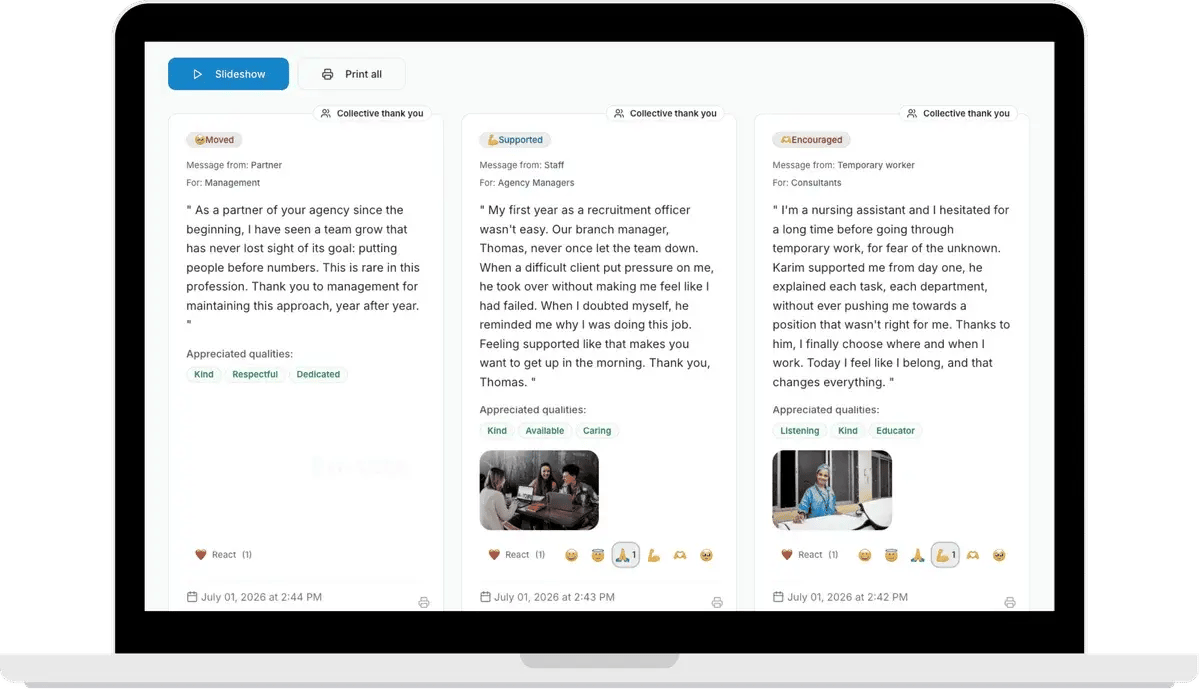
A team's gratitude wall, inside the Listen Leon platform.
« We have all three of our children followed by Dr. Bouvrot, and it's always a pleasure to come to the practice. We really feel listened to there, not like just another number or one more patient. She was the one who spotted our daughter's limp and took it seriously, which turned out to be osteochondritis. She also quickly identified that our second child needed ear tubes for her chronic ear infections. So it felt entirely natural to trust her with our third baby's care today. We especially value her simplicity and the quality of the exchanges with this doctor, who in my view goes beyond a simple medical conversation. »
A family, patient at Dr. Bouvrot's practice
« Thank you so much for your work, for the care given to our Lucie. We are grateful to all the nurses, all the doctors, all the staff. Everyone does everything they can to help us. We have been in intensive care for two weeks now, and every day we see the professionalism of the caregivers who work here. We appreciate your experience and your help. »
A family, in intensive care
« From the bottom of our hearts, thank you for all the care you showed in looking after our little Kiara Maria. You are part of her story, and we will be forever grateful. »
A family, to the care team
Recognition that flows in every direction
Patients, families and caregivers thank each other in every direction: from one ward to another, from one shift to the next, between doctors and allied staff. Every message joins the gratitude wall, like a personal guestbook.
Nursing assistants, orderlies, night staff: everyone receives their messages, with or without a professional email.
🇺🇸 Healthcare in the United States: recognition is the norm
Meaningful recognition is one of the six official standards for a healthy work environment in nursing, defined by the AACN (American Association of Critical-Care Nurses).
A program recognizing nurses through patients and families, now widely adopted across American hospitals, with over 2 million nominations submitted since it began.
According to Press Ganey's research on caregiver experience, recognition is among the factors that weigh most on the will to stay, alongside pay.
Sources: AACN Standards for Establishing and Sustaining Healthy Work Environments; DAISY Foundation; Press Ganey.
A poster for every ward
A comms kit with real team photos and a QR code, displayed at the entrance to the ward, in rooms or in hallways.
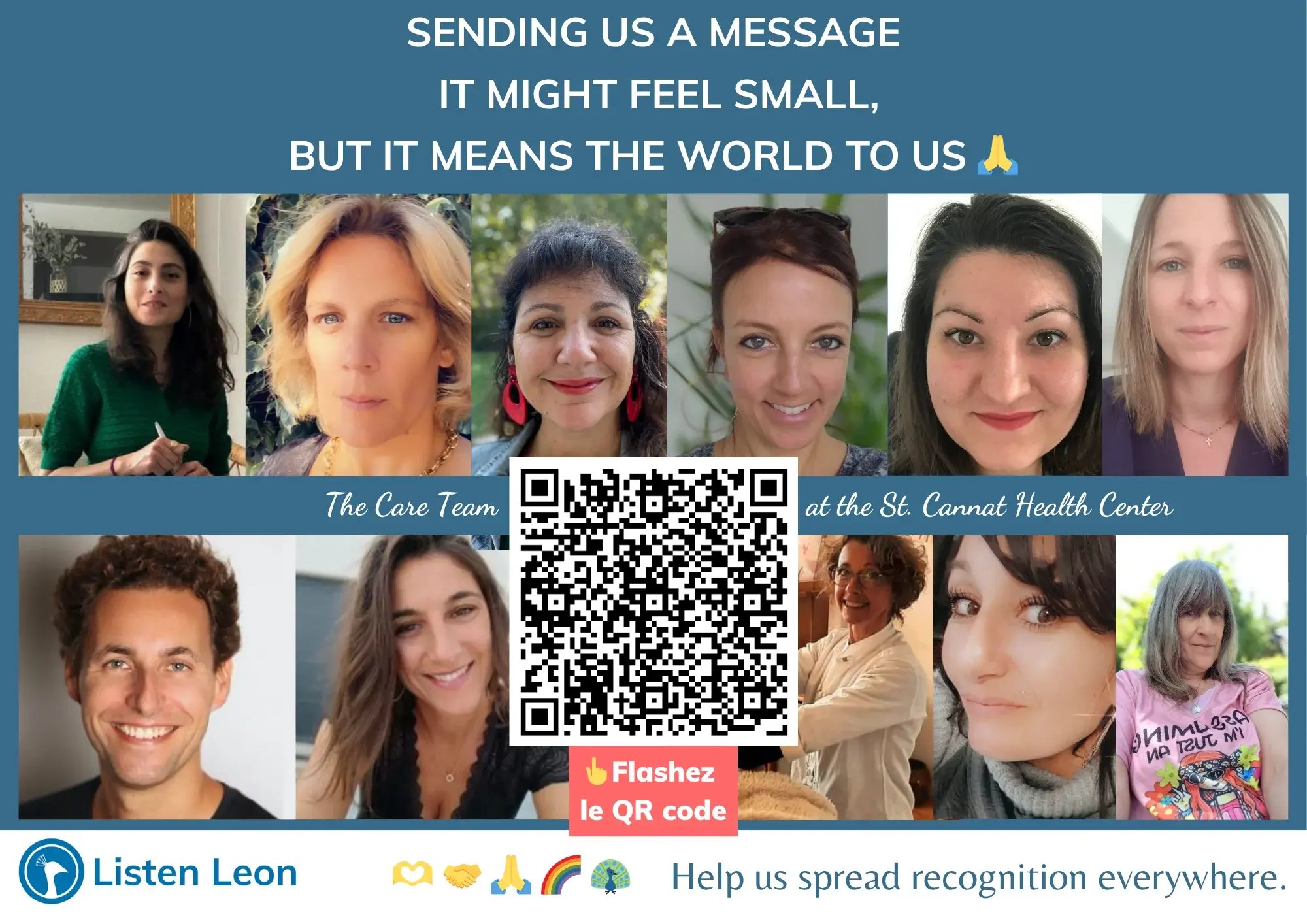
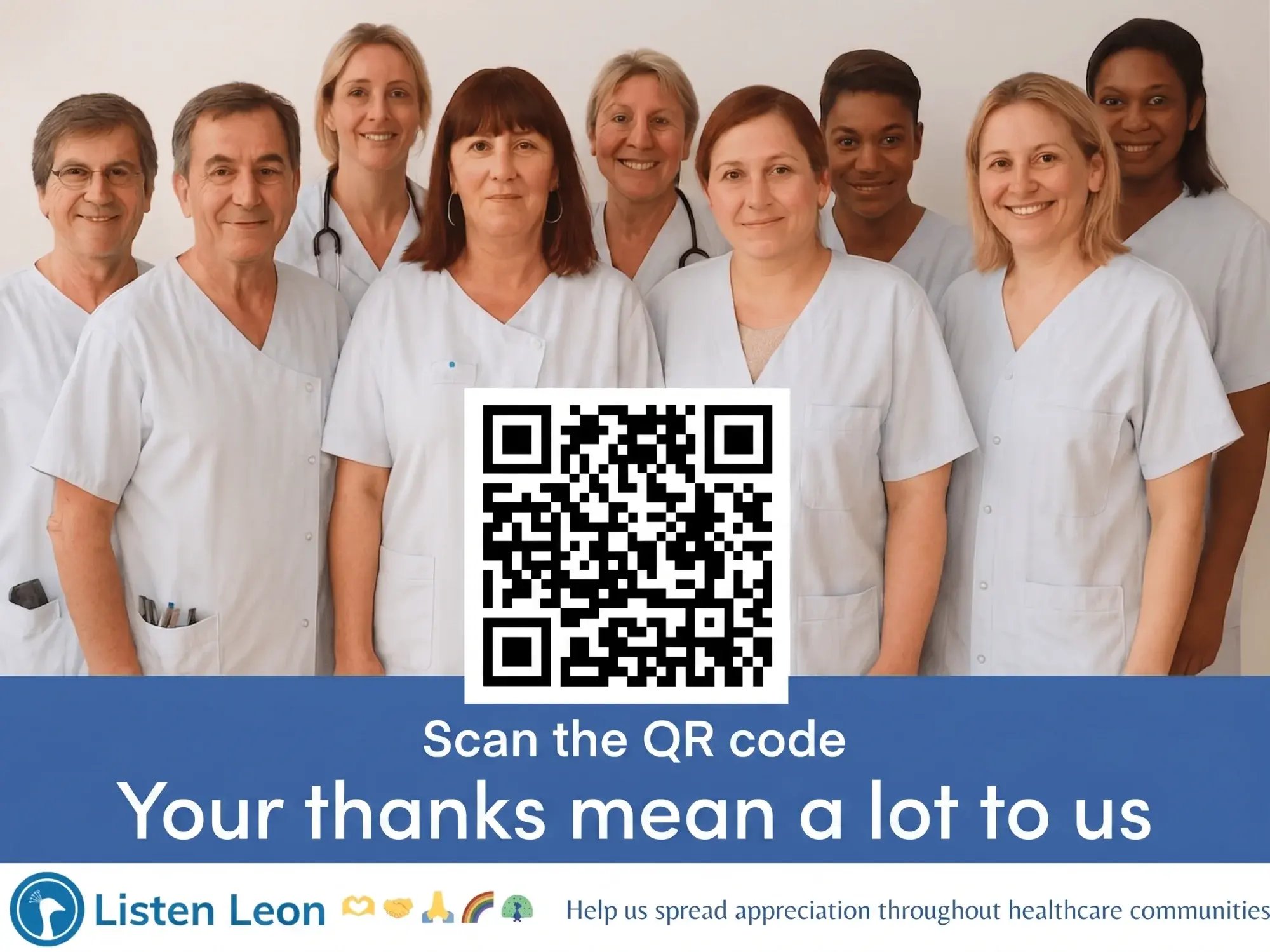
Customization example.
What Listen Leon changes for a healthcare facility
Caregivers see, in black and white, the impact of their work on real people.
Regular recognition protects against the wear caused by a vocation under sustained pressure.
Recognition between colleagues, between wards, between caregivers and administrative staff, starts to flow.
A dashboard tracks the recognition dynamic over time, useful for quality-of-work-life initiatives.
What a hospital department head says
Pr Barthélémy Tosello, head of the neonatal unit at Hôpital Nord in Marseille, explains what recognition from families changed for his teams. In French, with English subtitles.
Listen Leon in the media
France 2, the French national broadcaster, filmed recognition inside the hospital, in its prime-time news and in Télématin. Here is the Télématin report. In French, with English subtitles.
Go further on recognition in healthcare
Our guides, our research and real examples to dig deeper into the topic.
Figures, method and detailed feedback, including the Hopital Nord de Marseille example.
What research shows about recognition, motivation and burnout.
Why this shortfall weighs on caregivers' wellbeing and on organizations.
Airbus, hospitals and other organizations already making recognition flow.
The public wall of thank-you messages from a hospital ward already using the platform.
Ready to install recognition in your facility?
Discover the platform in a demo, or start by training your teams in the practice of recognition.
What care teams ask us
No. Access is through a QR code or link, on a personal phone or shared computer: no professional address is required, including for facilities that don't equip every staff member with a work email.
Yes, everyone chooses to write anonymously or signed.
No. These are words of thanks, never medical data. Hosted in Europe.
Patients, families and caregivers to each other: recognition flows in every direction (the 360° principle).
Every message is moderated, then the recipient is notified.
A few days, with a ready-to-use comms kit (posters and personalized QR codes).
Case study · AP-HM, Marseille
In neonatal intensive care, it is the parents who say thank you
54 thank-you messages in ten months, written by families and staff. The first public hospital department in France to deploy Listen Leon.
Read the case studyLet’s install recognition in your facility
See in a demo how patients, families and caregivers make recognition flow every day. Fast reply, no commitment.